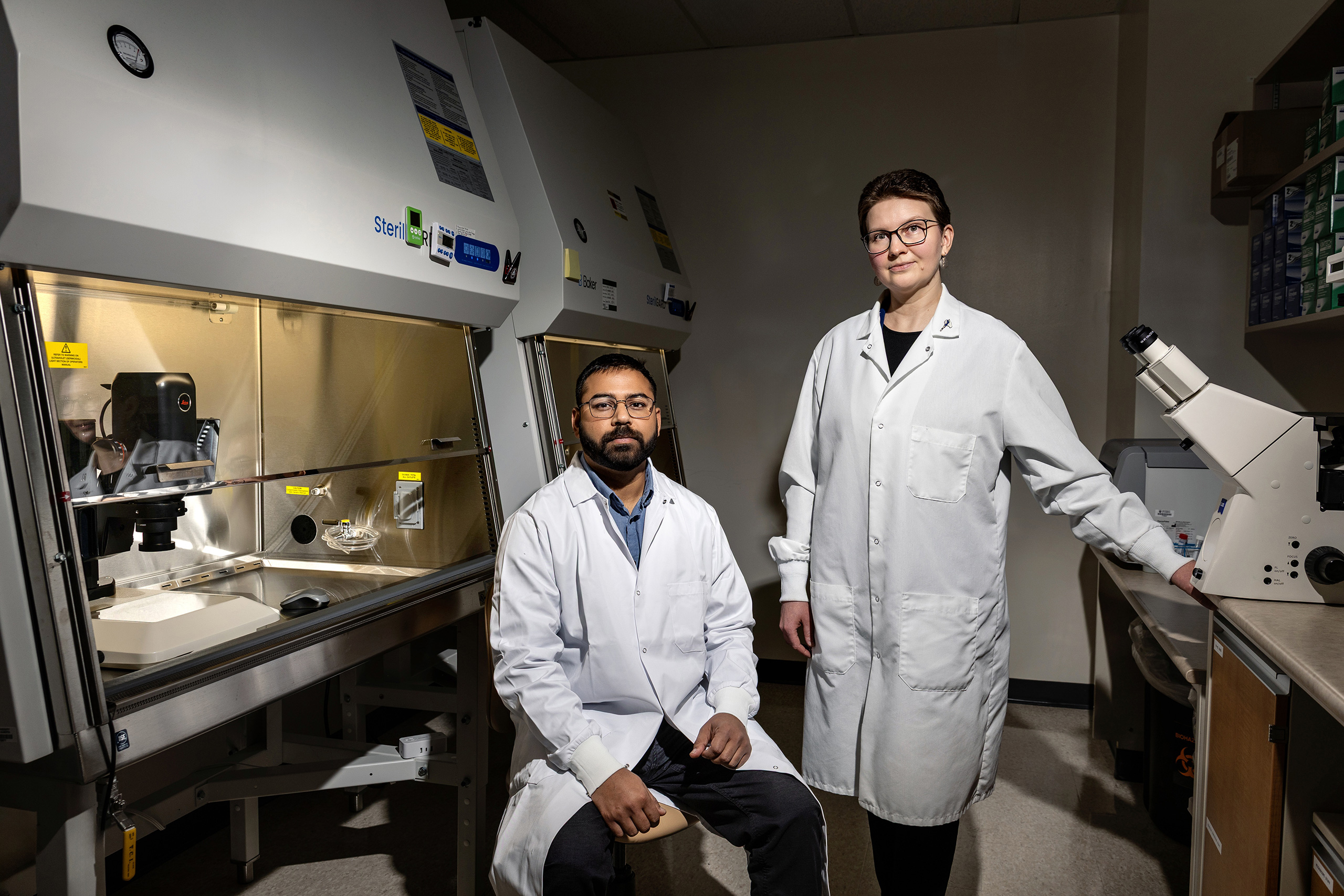
Researchers right here at the University of Alberta are growing three-dimensional, living models of human organs — miniature placentas, brains and spinal cords. It’s happening in the Stem Cell Core, established in 2025 by the Women and Children's Health Research Institute (WCHRI) to support research involving human stem cells — blank slates that scientists can guide to become nerve cells, heart cells or other tissues, or grow into 3D organoids that resemble human organs. The goal is to help researchers better understand diseases and conditions — including those affecting children and women — and to test therapies in systems that more closely reflect human biology than traditional animal models. “Ultimately, a human is not a mouse,” says Dr. Anastassia Voronova, academic lead of the core and an associate professor of medical genetics. There are considerable limitations to what can be learned from animal models, as well as logistical and ethical issues that limit the questions scientists can explore. Stem cell technologies let us study aspects of early human development that were essentially a black box before. — Dr. Sandeep Gupta Her colleague, Dr. Sandeep Gupta, an assistant professor of cell biology who joined the U of A and the core last year, focuses his research on fetal nervous system development, especially the brain and spinal cord. “Stem cell technologies let us study aspects of early human development that were essentially a black box before,” he explains. One of Gupta’s projects involves using cells from patients with autism spectrum disorder (ASD) to grow organoids of neural tubes (an early version of the spinal cord) to understand how spine development in the womb may contribute to the development of autism. “The idea is that some features of ASD could arise from neural circuit effects elsewhere in the nervous system, including the spine,” he says. Voronova’s research also centres around brain development and neurodevelopmental disorders. One of her current projects is a collaboration with WCHRI member Dr. Meghan Riddell, an associate professor of obstetrics and gynecology. With support from One Child Every Child, a national child health and wellness research initiative, they are exploring how placental problems during pregnancy may impact neurological development and, possibly, contribute to neurodevelopmental disorders. “By combining Dr. Riddell’s experience in placental organoids and our expertise in neural tube organoids, we can put them together in the same dish and ask, ‘How are these two organs influencing each other?’ ” says Voronova. It’s one of many physiological questions that could not be answered without using human cells and stem cell organoids. These collaborations demonstrate the core’s critical role, alongside the Translational Genomics Hub, in WCHRI’s and the U of A's broader push toward precision health, which connects patient data, artificial intelligence, genetics and human cell models to create personalized treatments that improve outcomes. Eventually, Voronova envisions the core increasing its capacity to provide lab services and training to researchers and students across the university. She notes that the high degree of technical expertise and financial investment can make stem cell research prohibitive to many scientists. “Ultimately, we want to reduce the barriers for researchers to dive into this world so they can explore the most translationally meaningful questions.” Story by Caitlin Crawshaw WCHRI is home to 33 Canada Research Chairs, including Anastassia Voronova, who is CRC in neural stem cell biology; 15 fellows of the Canadian Academy of Health Sciences and 5 endowed research chairs: Dawn Kingston, Cheng-Han Lee, Colleen Norris, Jane Schulz and Lonnie Zwaigenbaum. The Stollery Children’s Hospital Foundation supports the WCHRI Stem Cell Core and research conducted by doctors Anastassia Voronova and Sandeep Gupta. Gupta was recruited to the U of A from the David Geffen School of Medicine at UCLA thanks in part to SCHF funding.

Photos by William Au Leading the way in research